

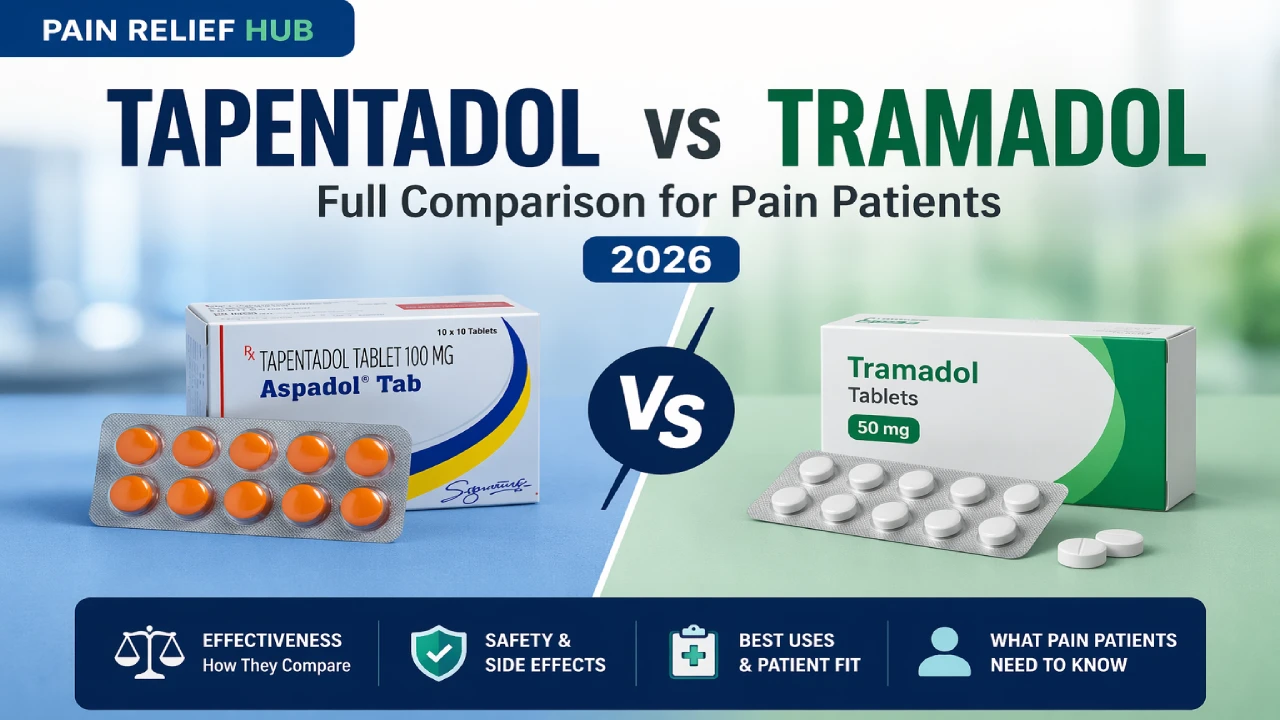
Quick Overview: Tapentadol vs Tramadol in 2026
If you are managing moderate to severe pain and your physician has mentioned either tapentadol or tramadol, you are right to want a clear, honest comparison before deciding. Both belong to the opioid analgesic class, both require a prescription, and both are widely prescribed in the United States — but they are not the same drug, and the differences between them are clinically significant.
This guide breaks down the pharmacology, real-world potency, tolerability, and appropriate use cases of tapentadol vs tramadol in 2026, helping you have an informed conversation with your healthcare provider. We also address the most frequently searched question: is tapentadol stronger than tramadol? (Short answer: yes.)
Quick Verdict
Tapentadol is generally 2–3× more potent than tramadol, has a more predictable pharmacological profile, causes fewer gastrointestinal side effects, and carries a lower risk of dangerous drug interactions. For chronic moderate-to-severe pain, tapentadol is frequently the preferred choice in 2026.
How Each Drug Works: The Pharmacology
Understanding how these two drugs work explains most of the clinical differences between them. They share a superficial similarity — both act on the central nervous system to reduce pain perception — but their mechanisms are meaningfully distinct.
Tapentadol: Dual Mechanism of Action
Tapentadol acts via two complementary pathways simultaneously. First, it is a mu-opioid receptor (MOR) agonist — it directly activates the same receptors as morphine or oxycodone, producing strong analgesic effects. Second, and uniquely, it is also a norepinephrine reuptake inhibitor (NRI), increasing norepinephrine levels in the spinal cord to modulate the descending pain inhibition pathway.
This dual action is what makes tapentadol particularly effective against neuropathic pain — a type of pain that pure opioids often struggle to address adequately. Because the same molecule handles both mechanisms, patients get consistent, reliable relief without needing two separate drugs.
Tramadol: Indirect and Metabolite-Dependent Action
Tramadol's story is more complicated. It is a weak mu-opioid receptor agonist in its native form, but its primary opioid activity comes from a metabolite called O-desmethyltramadol (M1), which is produced by the liver enzyme CYP2D6. This creates a significant clinical problem: about 7–10% of the Caucasian population are "poor metabolizers" of CYP2D6, meaning tramadol produces little to no opioid effect in these patients.
Tramadol also inhibits both serotonin and norepinephrine reuptake — a property that contributes to its pain relief but also raises the risk of serotonin syndrome, especially when combined with antidepressants, triptans, or other serotonergic drugs.
Tapentadol — Mechanism
- Direct mu-opioid receptor agonist
- Norepinephrine reuptake inhibitor
- No active metabolite required
- Consistent across all genetic metabolizer types
- Effective on both nociceptive and neuropathic pain
Tramadol — Mechanism
- Weak direct mu-opioid agonist
- Active metabolite (M1) via CYP2D6 required
- Serotonin + norepinephrine reuptake inhibitor
- Efficacy varies by genetic metabolizer status
- Higher serotonin syndrome risk with SSRIs/SNRIs
Potency & Strength: Is Tapentadol Stronger Than Tramadol?
Yes — tapentadol is stronger than tramadol, and by a meaningful margin. Clinical pharmacology data and equianalgesic conversion tables consistently place tapentadol at approximately 2 to 3 times the analgesic potency of tramadol on a milligram-per-milligram basis.
Tramadol is typically dosed at 50–100 mg every 4–6 hours, with a maximum of 400 mg per day. To achieve comparable pain control, patients need considerably less tapentadol — typically 50–100 mg every 4–6 hours as well, but the active opioid effect produced per milligram is substantially higher.
More importantly, because tapentadol does not depend on CYP2D6 conversion, its potency is consistent and predictable across patients. Tramadol's efficacy, by contrast, can vary dramatically — a patient who is a "poor metabolizer" may find tramadol nearly useless at any dose, while an "ultra-rapid metabolizer" may experience dangerously amplified effects.
Greater potency means greater analgesic effect — but also a higher potential for respiratory depression if misused or taken without medical supervision. Tapentadol is a Schedule II controlled substance in the USA, reflecting its higher abuse potential compared to tramadol (Schedule IV). Both should only be used under physician guidance.
Side Effects Compared: Which Is Better Tolerated?
Both drugs share common opioid side effects, but their tolerability profiles differ enough to influence prescribing decisions — especially for long-term use.
| Side Effect | Tapentadol | Tramadol |
|---|---|---|
| Nausea / Vomiting | Less frequent (20–30%) | More frequent (30–40%) |
| Constipation | Moderate — less than traditional opioids | Moderate to significant |
| Dizziness / Drowsiness | Present, dose-dependent | Present, dose-dependent |
| Seizure Risk | Very low | Clinically significant — lowers seizure threshold |
| Serotonin Syndrome | Very rare — no serotonergic action | Real risk — especially with SSRIs/SNRIs |
| Drug Interactions | Fewer significant interactions | Multiple CYP2D6 and serotonergic interactions |
| Headache | Occasional | Occasional |
| Respiratory Depression | Higher risk (Sch. II potency) | Lower risk at therapeutic doses |
From a tolerability standpoint, tapentadol generally wins on gastrointestinal side effects — a major driver of medication discontinuation among chronic pain patients. Tramadol's serotonergic mechanism creates unique risks that tapentadol simply does not have, particularly for patients on antidepressants, a large portion of the chronic pain population.
Tramadol's seizure risk is another practical concern. According to prescribing literature and reports reviewed by the FDA, tramadol lowers the seizure threshold — a risk amplified in patients with epilepsy, head injury, or those taking other CNS-active medications.
- Combining tramadol with SSRIs (sertraline, fluoxetine, escitalopram) risks serotonin syndrome
- CYP2D6 inhibitors (bupropion, paroxetine) block tramadol's M1 conversion, drastically reducing effectiveness
- MAO inhibitors (phenelzine, selegiline) create a potentially life-threatening interaction with tramadol
- Tapentadol carries none of these serotonergic interaction risks
Dosage, Forms & How They Are Taken
| Factor | Tapentadol | Tramadol |
|---|---|---|
| Available Strengths | 50 mg, 100 mg, 150 mg, 200 mg (IR & ER) | 50 mg, 100 mg, 200 mg, 300 mg (IR & ER) |
| Typical Starting Dose | 50–100 mg every 4–6 hours | 50–100 mg every 4–6 hours |
| Maximum Daily Dose | 600 mg/day (IR); 500 mg/day (ER) | 400 mg/day (IR); 300 mg/day in elderly |
| Onset of Action | ~30 minutes (IR) | ~30–60 minutes (IR) |
| Duration | 4–6 hours (IR); up to 12 hours (ER) | 4–6 hours (IR); up to 12 hours (ER) |
| Renal Dose Adjustment | Required in severe renal impairment | Required in moderate-severe renal impairment |
| Hepatic Dose Adjustment | Required in moderate hepatic impairment | Required in moderate hepatic impairment |
Tapaday 200 mg — available at Pain Relief Hub — delivers the highest commonly prescribed immediate-release dose of tapentadol in a single tablet, making it suitable for patients with established opioid tolerance who require stronger, consistent pain control throughout the day.
Which Pain Conditions Is Each Drug Best For?
Choosing between tapentadol and tramadol often comes down to the type and severity of pain, not just the drugs' raw potency.
Tapentadol Is Preferred For:
- Diabetic peripheral neuropathy — dual mechanism addresses both nociceptive and nerve pain components
- Chronic low back pain with neuropathic features (radiating, burning, stabbing character)
- Post-surgical pain requiring reliable, potent short-term analgesia
- Cancer-related pain at moderate to severe intensity
- Patients on antidepressants where tramadol's serotonergic risk is unacceptable
- Patients who have failed tramadol due to inadequate response or poor metabolizer status
Tramadol May Still Be Used For:
- Mild to moderate acute pain where the lower potency is appropriate and sufficient
- Patients without seizure disorders or serotonergic drug regimens
- Situations where a Schedule IV (lower-control) opioid is preferred clinically or regulatorily
- Post-operative dental or orthopedic pain at lower intensity
- Opioid-naïve patients starting pain management for the first time
The International Association for the Study of Pain (IASP) and major clinical guidelines increasingly support tapentadol as the preferred opioid for mixed pain syndromes involving both nociceptive and neuropathic components — conditions where tramadol often falls short.
Addiction & Dependence Risk: What You Should Know
Both tapentadol and tramadol are controlled substances and both carry potential for physical dependence, tolerance, and misuse. Neither should be taken recreationally or outside of a medical relationship.
| Factor | Tapentadol | Tramadol |
|---|---|---|
| DEA Schedule (USA) | Schedule II (high abuse potential) | Schedule IV (lower abuse potential) |
| Physical Dependence | Yes — with prolonged use | Yes — with prolonged use |
| Psychological Cravings | Possible with chronic use | Possible with chronic use |
| Withdrawal on Discontinuation | Taper required; manage under physician care | Taper required; serotonergic withdrawal also possible |
| Euphoria / Reward | Present — direct opioid receptor action | Lower — weak direct opioid action |
Tramadol's Schedule IV status gives a misleading impression to some patients that it is entirely safe or non-addictive. The CDC's opioid prescribing guidance has noted cases of significant tramadol dependence, and several countries have upgraded its scheduling in recent years. The risk is real for both drugs when used improperly.
Physical dependence — the body adjusting to the presence of a medication — is a predictable physiological response to any opioid, distinct from addiction. Patients taking tapentadol or tramadol as prescribed, under medical supervision, for a legitimate pain condition are not by that fact "addicted." Always discuss any concerns about dependence with your treating physician.
The 2026 Verdict: Which Should You Choose?
After evaluating mechanism, potency, tolerability, drug interactions, and appropriate use cases, the clinical picture for 2026 is clear:
Tapentadol Wins for Moderate-to-Severe Chronic Pain
More potent, more predictable, fewer drug interactions, and better tolerated on the GI system. Preferred by pain specialists for neuropathic, mixed, and chronic pain conditions in 2026.
That said, tramadol retains a legitimate clinical role. For opioid-naïve patients with mild-to-moderate acute pain, or in settings where Schedule II prescribing creates access barriers, tramadol remains a valid option — provided the patient has no serotonergic drug regimen and no seizure history.
The choice between these two drugs is ultimately a clinical decision made with your physician. What this article gives you is the knowledge to have an informed, productive conversation about which medication is appropriate for your specific pain type, medical history, and treatment goals.
Tapaday 200 mg — Tapentadol at Peak Therapeutic Strength
For patients who need the full clinical benefit of tapentadol at 200 mg, Tapaday 200 mg is available through Pain Relief Hub — a trusted online pharmacy serving patients across the USA with genuine, manufacturer-sourced medications and discreet home delivery.
Tapaday 200 mg — Tapentadol Tablets
From $96.00High-strength 200 mg tapentadol tablets for moderate-to-severe chronic pain. Discreet packaging. Fast, tracked shipping nationwide across the USA. Genuine product sourced from verified manufacturers.
Buy Tapaday 200 mg →If you are earlier in tapentadol treatment or transitioning from tramadol, Pain Relief Hub also carries Aspadol 50 mg and Aspadol 100 mg tapentadol tablets — allowing dose titration from the most appropriate starting point. For neuropathic pain management alongside opioid therapy, consider whether Nervisign 300 mg (Pregabalin) or Gabasign 800 mg (Gabapentin) could complement your pain management plan — both are available at Pain Relief Hub.
Frequently Asked Questions
Related Articles & Products
- Buy Tapaday 200 mg Tapentadol Tablets
- Aspadol 100 mg Tapentadol Tablets
- Aspadol 50 mg Tapentadol Tablets
- Nervisign 300 mg Pregabalin — For Nerve Pain
- Lyrikare 300 mg Pregabalin Capsules
- Gabasign 800 mg Gabapentin Tablets
- Prebasun 450 mg Pregabalin Capsules
- Pain-O-Soma 350 mg Muscle Relaxant
- Pain Relief Hub Blog — More Guides
- Frequently Asked Questions — Pain Relief Hub